
First, a disclaimer: I am a sucker for almost anything Star Trek, so of course I love Discovery, Picard, and Lower Decks (haven’t yet taken Prodigy for a spin, but I’ll get there).
The reason I start with that doth protesting too much is that it’s rough mentioning anything to do with “NuTrek”, the period beginning with the release of Star Trek: Discovery in 2017, without incurring fannish wrath from vocal minorities. To say these shows have had mixed responses is putting it kindly: an M and M’s party-size Mix-Ups bag isn’t as mixed as this, and it’s probably gotten more consistently-positive reviews, too. That’s what makes talking about Strange New Worlds, the latest live-action jaunt to the final frontier, all the more difficult, given it was made almost entirely as a response to the gripes of those minorities. To say I adored Strange New Worlds runs the risk of implying it’s because it’s antithetical to everything “NuTrek”, which in many ways it is. But nothing could be further from the truth.
Those other “NuTrek” shows are certainly a marked departure from the style and tone of Trek‘s golden era. The likes of The Next Generation and Voyager were optimistic, fluffy and consistently cerebral, but above all they were fun. Even Deep Space Nine, the first serialised Trek and one that was unafraid to tear Gene Roddenberry’s utopia to shreds, had final season episodes – taking place during a massive intergalactic war – about the crew challenging Vulcans to a baseball game and staging a heist in a holographic 1960s Vegas casino. Even in moments of darkness, Trek looked up to the sky, something Lower Decks has also taken to heart with its irreverent, good-natured self-parody.

By contrast, Discovery begins with a major, gruesome war against the Klingons that encompasses its entire first season, which itself alone had torture, war crimes, sadistic Mirror Universe doppelgangers and a main character who was ostracised for starting that war. Picard didn’t start any nicer, dealing with aging, loss and the slow march towards death in its own premiere. Both shows are great, but they’re not uplifting. A frequent accusation against “NuTrek” is its nihilistic worldview and gritty drama bleaching all the fun away, leaving us with shows that, while compelling in their own ways, aren’t as buoyant as their predecessors. In this time and place, especially, that’s a problem.
The world isn’t kind right now. 2022 isn’t even at the halfway mark, and it’s bleak. Ukraine. Repealing Roe v. Wade. (More) Australian floods. Continued COVID illnesses and deaths. Ongoing climate crises. The world is hell.
And here’s Strange New Worlds to tap you on the shoulder and say, “It’s alright, things are bad, but they will get better.”

From the first scene of its pilot episode, when First Officer Una Chin-Reilly (Rebecca Romijn) narrates the wide-eyed experience of first contact with an alien race, Strange New Worlds is on a whole other track. During the episode, we have Spock (Ethan Peck) flirting Vulcan-style with his fiancee T’Pring (Gia Sandhu), and a runaway alien being chased through the Enterprise corridors by Nurse Chapel (Jess Bush) who’s only stopped when Cadet Uhura (Celia Rose Gooding) strikes up a chat with him about his favourite sports team. The central conflict, a pre-warp society who’s accidentally invented a warp-drive bomb, is unpinned by inspiring speeches, diplomacy and optimism. Throughout its premiere, Strange New Worlds stakes a claim as one of the most enjoyable shows to hit TV this year. It’s kind. It’s thoughtful. It’s fast-paced. It’s fun.

That’s not to say it doesn’t have moments of darkness. The central conflict for Captain Christopher Pike (Anson Mount) is the knowledge of how and when he will die in a decade’s time, knowledge gleaned from a time-twisting encounter in Star Trek: Discovery‘s second season. Throughout the episode Pike struggles to function in the face of that horrible certainty, unsettled by frequent moments of seeing his horrifically-scarred future visage reflected in glass surfaces. But as the episode progresses, he’s learned to live with the life that is yet to come before that terrible moment. He understands there’s still time to make things better, a fact he hammers home to the aliens he mediates by showing them the horrors of Earth conflicts – some of them uncomfortably similar to the ones that both the aliens and real-world Earth are experiencing now – and arguing that something good can blossom despite that darkness. By episode’s end, Pike faces his life with confidence, summing it in his Captain’s Log: “We can go forward together knowing that whatever shadows we bring with us, they make the light all the brighter.” Things might not be ok, but they can be. They will be, because – to borrow from another famous captain – we will make it so.

At a time when things in our world are still so bleak, Strange New Worlds is a welcome return to fun, inspiring Trek. Its characters are well-drawn from the word go: unlike the under-developed bridge crew of Discovery, I already want to know more about Nurse Chapel, Lieutenant Ortegas (Melissa Navia) and Lieutenant La’an Noonien-Singh (Christina Chong), each of whom get great moments throughout. The central plot is simple and effective, and it’s solved by a turn of grand speechifying from Pike that sits alongside the best of Picard and Janeway. As with that speech, the dialogue is heavy when it needs to be but it brings a lot of endearing lightness, too: when the runaway alien escapes Enterprise‘s sickbay, Lieutenant Ortegas – commanding the ship while Pike is away – exasperatedly sighs, “Always when I’m in the Captain’s chair.” The show’s ability to expertly key into viewer emotions on a whim meant I watched alternately with a giant smile and very wet eyes.
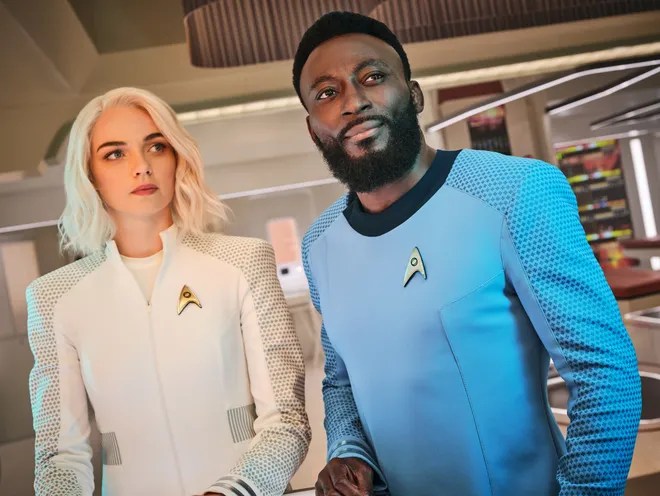
I was lucky to be alive at a time and place when shows like The Next Generation were airing, experiencing those wonderful episodes for the first time as an eager young fan. Strange New Worlds is a return to the experience of wonder that Star Trek has sorely needed over the past few years, and now more than ever. It knows there was something golden in the episodic, big-feelings formula of its halcyon years, contrasting with Discovery and Picard favouring cerebral, dark-and-gritty serialisation with mixed results. If its first episode is any indication, these strange new worlds of Strange New Worlds are both a welcome familiarity and a chance to once again boldly go where no-one has gone before.

![We need to stop saying “[new show] is like Game of Thrones”](https://livesonscreen.com/wp-content/uploads/2024/11/thrones-1.webp?w=1024)


 Lives On Screen
Leave a comment